Biodiversity Duty Report, 1st January 2024 – 31st December 2025
- Introduction
The Biodiversity Duty (the Duty), originally contained in the 2006 Natural Environment and Rural Communities Act, required local authorities to ‘have regard to’ biodiversity in carrying out their functions. The 2021 Environment Act strengthened the Duty to a consideration of what is done to ‘conserve and enhance’ biodiversity.
By 1st January 2024, public authorities were required to consider what they can do to meet the Duty, and agree on policies and specific objectives based on that consideration. The council executed this through a refresh of the previous Environment Strategy, producing a new Climate Strategy and Action Plan in December 2023, covered further in Section 2 of this report.
From 1st January 2026, authorities must report on actions taken to achieve biodiversity objectives to date, as well as report on planned actions. For planning authorities, like Rother District Council, these Duty reports must also include information on actions carried out to meet Biodiversity Net Gain (BNG) obligations, details of approved biodiversity gain plans, and how future BNG obligations will be met (see section 5).
This is Rother’s first Biodiversity Duty report, covering actions taken over the period 1st January 2024 to 31st December 2025.
- Council policies and objectives
- Climate Strategy and Action Plan
Biodiversity and Land Use is one of the five action areas (shown in Fig. 1) of the council’s current Climate Strategy and action plan, with the objective that nature will be in recovery across the district by 2030. The list of the Biodiversity and Land Use actions, aiming to halt land and marine species decline and increase biodiversity, is provided in Appendix A.

The strategic approach draws heavily upon implementing biodiversity policies in the emerging Local Plan, as well as working in partnership with relevant statutory bodies and community groups, sharing information through corporate communications, and enabling action through grant-giving opportunities. The strategy also commits the council to assess the open spaces that it owns and enhance these for nature through wilding and tree planting, where appropriate.
The Climate Strategy sets out that Rother has a relatively high baseline for biodiversity, with a large areas of protected landscape; 83% of Rother falls within the High Weald National Landscape, and a further 7% is protected by national or international conservation designations. Ancient woodland covers more than 15% of the district, the highest percentage in the South East. However, significant barriers remain for biodiversity, including in protected areas, due to agriculture and other human impacts.
Regular updates on progress to deliver the Climate Action Plan are reported to the Climate Change Steering Group, with annual highlights published on the webpage Our climate action so far.
- Draft Local Plan 2025 – 2042
The draft Local Plan, providing the blueprint for how Rother could develop and change up to 2042, was published for a first public consultation in April 2024. It sets out where new homes, jobs, facilities and infrastructure may be located, while protecting the district’s valued landscapes, heritage and character.
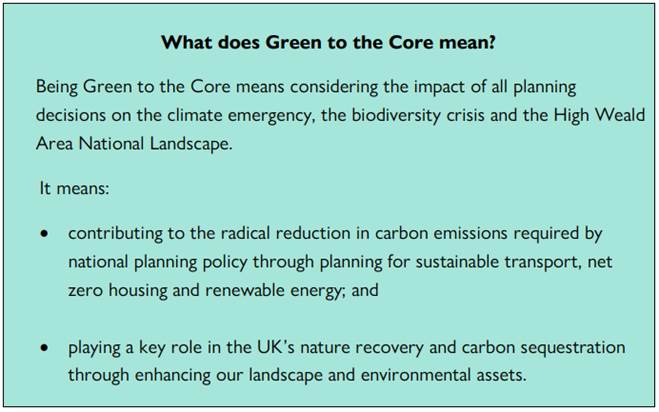
The Local Plan’s vision recognises the climate and biodiversity emergencies, with one of the twin overall priorities being Green to the Core, defined in Figure 2.
One of the 10 key plan objectives is to maximise opportunities for nature recovery and biodiversity net gain and preserve the historic landscape character of the High Weald National Landscape and protected habitat areas of Rother, and ensure sensitive development that allows communities to thrive.
Biodiversity is extensively considered through the Local Plan documents, underpinned by supporting evidence and reviews, including:
- Rother Climate Change Study – Net Zero Carbon Evidence Base Report (July 2023)
- Rother Local Plan Regulation 18 Habitats Regulation Assessment April 2024
- Sustainability Appraisal Report, April 2024
- Environmental Management Background Paper, April 2024
- Climate Change and Live Well Locally Background Paper, April 2024
A summary of the key draft policies relating to the conservation and enhancement of biodiversity is provided in Appendix B.
A further public consultation, this time including proposed site allocations, is due to take place between January and March 2026. Following this, the final Local Plan will be published for comment before it is submitted to the Planning Inspectorate for independent examination, expected in December 2026.
- Council Plan
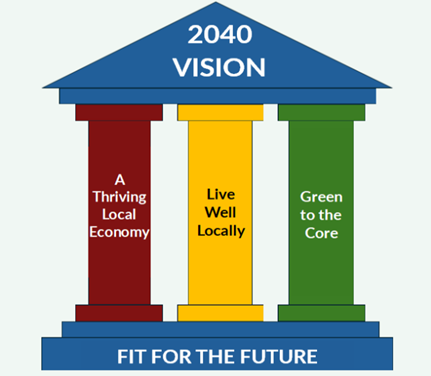
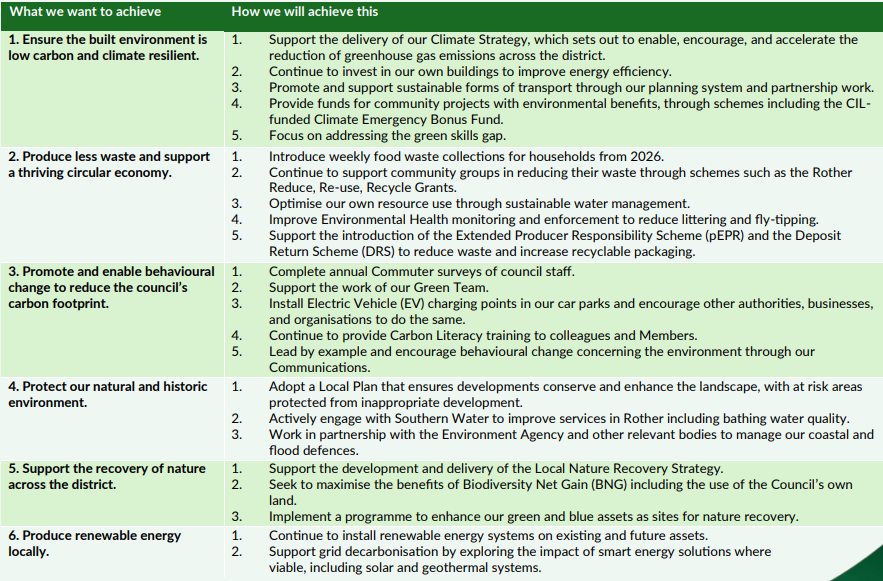
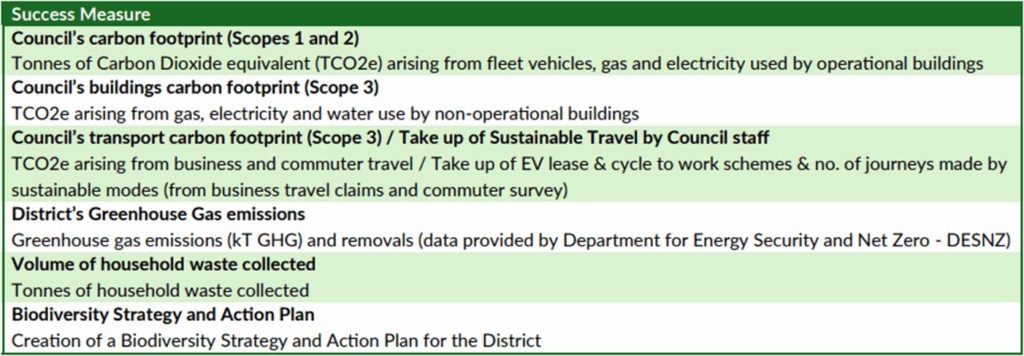
Both draft Local Plan priorities were incorporated into the pillars of the latest Council Plan (see figure 3), adopted in December 2024. The vision for the Green to the Core pillar is that Rother will be recognised for leading the response to the climate and biodiversity emergencies. The plan commits the council to take bold action to tackle climate change and protect the environment in all that we do.
The full list of Green to the Core actions and success measures is provided in Appendix C.
The plan is reviewed on an annual basis by the Overview and Scrutiny committee, and going forward, it will be integrated into service planning.
- Action taken to meet the Duty (1st January 2024 – 31st December 2025)
- Working with partners and stakeholders
Council officers and elected members represent Rother’s interests at a range of regional and local groups that set strategic direction for biodiversity improvement. Arguably, the most significant is the working group for the Sussex Local Nature Recovery Strategy (LNRS), where the council sat as a supporting authority. The draft LNRS was published in 2025 and is expected to be adopted in early 2026. The Council is also a formal partner of the South East Rivers Trust’s Rother and Romney Catchment Partnership, including the Combe Valley Catchment sub-group, and the Cuckmere and Pevensey Catchment Partnership. These partnerships work to conserve and improve the health of local water environments and protect, restore and create wildlife habitats. Additional groups with biodiversity objectives include the Ashdown Forest Working Group, Southern Water Stakeholder Group, Combe Valley Countryside Park CIC Stakeholder Group and the Rother Food Partnership, to name a few.
The council are the accountable body for the Bexhill Neighbourhood Board in delivering the 10 year Pride in Place Programme for Bexhill, funded by MHCLG (Ministry of Housing, Communities and Local Government). The Neighbourhood Board Plan for the first 4 years was submitted in November 2025, which includes a priority for greening projects under the Thriving Communities workstream, aiming to enhance the town centre high streets as well as hyper-local areas where communities identify this as a priority.
The council has been working with the Environment Agency to design the aspects of the Pevensey Bay to Eastbourne Coastal Management Scheme that fall within Rother, which includes plans to protect and enhance an area of vegetated shingle habitat at Norman’s Bay, classed as an area of particular importance for biodiversity.
Council officers also took part in various community engagement events to showcase our climate strategy and action plan, such as running a workshop for students at Bexhill College’s Green Week in March 2024, and running a stall at the Love Our Rother event in Rye, organised by plastic-pollution charity Strandliners, in February 2025. Through 2024/25, the Council also supported local community groups and Parish & Town councils with advice on writing and funding their own biodiversity plans.
- Managing and improving council-owned land
Through 2024, Biodiversity Audits were completed on 23 of the council’s larger rural green assets and open spaces, to provide an overview of biodiversity at each site. The audits helped to form an evidence base to identify opportunities to improve the management of these areas for nature. Sites were selected based on a potential wildlife corridor between Rye Harbour Nature Reserve, SSSI, and the High Weald AONB (now High Weald National Landscape) at the northernmost part of the District.
The council continued to deliver on its prior commitment to refrain from the use of peat in the grounds maintenance contract, and to minimise the use of pesticides and herbicides, which are primarily now only used to control weeds growing on hard surfaces.
Following a successful application to DEFRA’s Coronation Living Heritage Fund, two micro woods were planted in early 2025. Each micro wood, one at Coronation Gardens recreation ground, Battle, and the other in Mason’s Field, Rye, comprises 1,000 trees and brought local residents together through community tree planting events.
Significant progress was made in achieving the objectives of the Bexhill Tree Planting Strategy (published in 2023), with planting completed on 10 of the 13 priority sites. The remaining three sites were school playing fields and not considered appropriate for planting, therefore tree planting was completed at three alternative sites in the area.
The council continued to provide space for local groups to deliver tree planting and biodiversity projects, including a community orchard in Rye and trees in and around Bexhill Down. Land was also provided for Bexhill Environment Group to create new wildflower meadows at Bexhill Down and Galley Hill.
- Grant funding for biodiversity projects
Between November 2024 and March 2025, the council administered the first round of a community orchard grant scheme, funded by DEFRA’s Coronation Living Heritage Fund. This resulted in community groups and Parish Councils receiving grants to plant a total of 123 fruit and nut trees across 10 community orchards in the district.
In December 2025, the council’s long-standing community grants scheme was refreshed, following a new partnership with the Sussex Community Foundation. Community grant funding eligibility criteria are now based on the aligned priorities of the Sussex Community Foundation and the council, including the category of Acting on Climate/Green to the Core, making funding available for environmental conservation and biodiversity projects.
- Strengthening our commitments to biodiversity
At Full Council on 15th September 2025, motions were passed for the rights of rivers and the rights of trees, showing the council’s support for the growing global movement for rights of nature as a framework for rethinking the relationship between human beings and the natural world.
The council also formally declared a Nature Emergency on 15th December 2025, making commitments to, amongst others, continue to embed nature’s recovery at the heart of all strategic plans, policy areas and decision-making processes, and to tackle the climate and nature emergencies together, investing in nature-based solutions to climate change.
- Actions to be taken in the next reporting period, 1st January – 31st December 2026
Over the next 12 months, the council will continue to work in partnership with stakeholders and local groups to set the strategic direction for nature recovery throughout the district. Once the Sussex LNRS has been published, consideration will be given to how Rother’s important areas for biodiversity can be protected and enhanced through a district-wide Biodiversity Strategy and Action Plan, and a district-wide Tree Strategy.
During this period, the council will be exploring opportunities to create habitat banks that create BNG units on the council’s estate landholdings. Building on the initial BNG site assessment work, the council is now speaking with ecologists and land advisors to understand routes to developing BNG on the land it holds.
In addition, we are exploring opportunities to work with landowners in the district to maximise BNG potential, such as within Combe Valley Countryside Park. As part of this, the council is currently exploring the freehold disposal of Hoads Wood to the leaseholder to support their objective of developing BNG credits on the land.
As mentioned in section 2 above, the draft Local Plan is expected to be submitted to the Planning Inspectorate for independent examination in December 2026, for adoption in 2027.
Further delivery of the existing Tree Planting Strategy for Bexhill will take place, with 30 trees already scheduled to be planted in Broad Oak park, the Polegrove, Bexhill Cemetery, St. Mary’s Park, and Bexhill Down. The remainder of the Coronation Living Heritage Fund grant will also allow for further tree planting, including another micro wood at Bulverhythe recreation ground, Bexhill, to be planted in partnership with Groundwork South, plus three more community orchards.
The existing commitment to minimise the use of pesticides and herbicides will be put before Full Council to be formalised into policy, and further embedded into grounds maintenance plans.
- Biodiversity Net Gain information
From 12th February 2024,BNG has been mandatory for new planning applications for major development made under the Town and Country Planning Act (TCPA) 1990, subject to the confirmed exemptions. Major development includes residential developments with 10 or more dwellings, or where the site area is greater than 0.5 hectares. BNG for small sites had an extended transition period and came into force from 2nd April 2024.
Prior to the 1st January 2024, and with the mandatory requirements ahead in mind, the council began using a software tool (Mycelia) that helps local planning authorities to manage BNG requirements, including the validation and assessment of planning applications through to monitoring and reporting. Every planning application that has been subject to mandatory BNG is required to use a biodiversity metric tool(s) to calculate the on-site biodiversity value(s), which are entered into and saved to Mycelia.
Whilst the council has processed and granted many planning permissions for development that is subject to mandatory BNG since the requirements came in, only seven of these have so far had BNG gain plans submitted by applicants and subsequently approved. These are summarised below.
- Planning application reference: RR/2024/1808/P
Address: Quarter Mile Farm, Battle
Development: Replacement barns and stable buildings.
The approved BNG Plan (discharge of conditions application reference RR/2025/1027/DC) consists of the planting of ten native trees (Oak, Field Maple and Silver Birch) along the site boundary and 175 square metres of mixed scrub (Hawthorn and Hazel).
- Planning application reference: RR/2025/194/P
Address: Whitelands – land adjacent, Battle
Development: Erection of one dwelling
The approved BNG Plan (discharge of conditions application RR/2025/851/DC) involves the planting of 20m of native hedgerow along the site boundary.
- Planning application reference: RR/2025/223/P
Address: Land at Swan Farm, Battle Road, Woods Corner, Dallington
Development: Conversion and adaption of existing barns and new link element to create new dwelling. New landscaping, parking and gardens and biodiversity enhancements and use of access to Battle Road.
The approved BNG Plan (discharge of conditions application reference RR/2025/1781/DOC) consists of the retention of existing native hedgerow, planting of nine native fruiting trees, enhancement of modified grassland to other neutral grassland (0.045 ha) and the planting of 46m native hedgerow.
- Planning application reference: RR/2024/1272/P
Address: Bough Oast, Heathfield Road, Burwash
Development: Construction of 40m x 20m Riding Arena, plus Biodiversity Enhancement.
The approved BNG Plan RR/2025/1181/DC – The Biodiversity Net Gain Plan confirms that 19.10% BNG in habitat units (neutral grassland) and 61.15% BNG in hedgerow units (0.097km of native hedgerow on site) will be achieved.
- Planning application reference: RR/2024/1971/P
Address: Powdermills Hotel, Powdermill Lane, Battle
Development: Erection of new single storey building to be used as a wellness centre (gym and studios), formation of 2no. padel tennis courts, and the laying of hard standing to create additional car parking with associated ground works and landscaping.
The approved BNG Plan (discharge of conditions application reference RR/2025/1875/DOC) confirms a gain of 11.24% in habitat units (other neutral grassland – ONG) and 0.12% in hedgerow units on-site and off-site, but within land owned by the applicant.
- Planning application reference: RR/2024/2052/P
Address: 81 Cooden Drive, Bexhill
Development: Demolition of existing bungalow and garage, replacement with five flats and a dwelling, parking for nine cars, stopping up of an existing driveway and construction of new access and highway crossover. (Alternative to planning permission RR/2021/1519/P (allowed on appeal)).
The approved BNG Plan (discharge of conditions application reference RR/2025/1677/DC) details a mix of on-site BNG (grassland and trees) and off site BNG (Nature Impact).
- Planning application reference: RR/2024/1040/P
Address: Cornerways, School Lane, Peasmarsh
Development: Demolition of existing dwelling and outbuildings. Construction of replacement dwelling and carport, together with improvements to existing vehicular access.
The approved BNG Plan (discharge of conditions application reference RR/2025/511/DC) details that the applicant purchased 0.49 units off-site from a Habitat Bank (HB) operated by the Environment Bank as on-site net gain was not achievable.
For the next reporting period of 1st January – 31st December 2026, the council will continue to use the software tool (Mycelia) to manage BNG requirements, including the validation and assessment of planning applications, together with monitoring and reporting. Every planning application subject to mandatory BNG will continue to be required to use a biodiversity metric tool(s) to calculate the on-site biodiversity value(s), which will be entered into and saved to Mycelia.
Appendix A: Biodiversity and land use actions from the council’s Climate Action Plan.
Objective 4.1 Halt land and marine species decline.
Objective 4.2 Increase biodiversity and carbon sequestration.
| No. | Action | How will we measure success? | Due date | Lead Service Area/s |
|---|---|---|---|---|
| 4.1.1 | Promote initiatives and events through comms, networks and Council webpages to improve water and land management practices. | Report on webpages refreshed/created and publicised, no. of events supported/publicised. | ongoing up to 2030 | Corporate and Strategic Services (Climate) |
| 4.1.2 | Develop and deliver projects/grant schemes where funding is available to improve water and land management practices, either stand-alone or in partnership. | Report on no. of projects supported and project outputs. | ongoing up to 2030 | Corporate and Strategic Services (Climate) |
| 4.1.3 | Participate in relevant groups, such as River Catchment Partnerships and Sussex Nature Partnership, and respond to relevant consultations. | Report on membership of groups, output of groups. | ongoing up to 2030 | Planning |
| 4.1.5 | Resolve reports of defective drainage through Environmental Health engagement and enforcement. | Report on complaints, interventions and outcomes. | ongoing up to 2030 | Environmental Services and Licensing |
| 4.1.6 | Develop a natural/open spaces asset management plan which designates a minimum 10% of Council owned natural assets to ‘wilding’ and nature recovery, with consideration to BNG and carbon credit opportunities | Plan adopted by Council. | 2026/27 | Housing – Estates, Corporate and Strategic Services |
| 4.1.7 | Increase areas of Council operated parks, gardens and green spaces managed for nature, for example, through revised mowing regimes, native planting or incorporating recommendations of the biodiversity audits (2023). | Revised practices adopted through the Grounds Maintenance Contract. | ongoing up to 2030 | Corporate and Strategic Services (Parks) |
| 4.1.8 | Introduce Nature Recovery conditions to new Council lease agreements | Report on no. of new leases with Nature Recovery clauses included | ongoing up to 2030 | Housing – Estates |
| 4.1.9 | Eliminate use of pesticides, herbicides and peat in council grounds maintenance. | Policy adopted by the Council | 2028/29 | Corporate and Strategic Services (Parks) |
| 4.1.10 | Work in partnership with Southern Water to improve bathing water quality, for example through works at Egerton Park | Report on projects supported and outputs. | ongoing up to 2030 | Corporate and Strategic Services (Parks) |
| 4.2.1 | Promote initiatives and events through comms, networks and Council webpages to increase biodiversity and carbon sequestration. | Report on webpages refreshed/created and publicised, no. of events supported/publicised. | ongoing up to 2030 | Corporate and Strategic Services (Climate) |
| 4.2.2 | Develop and deliver projects/grant schemes where funding is available to increase biodiversity and carbon sequestration, either stand-alone or in partnership. | Report on no. of projects supported and project outputs. | ongoing up to 2030 | Corporate and Strategic Services (Climate) |
| 4.2.3 | Create a Biodiversity Strategy and Action Plan for the District, once the Local Nature Recovery Strategy and Emerging Local Plan have been adopted. | Strategy and Plan adopted. | 2028/29 | Corporate and Strategic Services (Climate, Parks), Planning |
| 4.2.4 | Deliver on Bexhill Tree Planting Strategy | Report on actions supporting Bexhill Tree Planting Strategy objectives | ongoing up to 2030 | Corporate and Strategic Services (Parks) |
| 4.2.5 | Develop District-wide Tree Strategy | Strategy adopted. | 2026/27 | Corporate and Strategic Services (Climate, Parks), Planning |
| 4.2.6 | Maximise social value and climate action in Neighbourhood Services contracts. | Report on social value and climate action delivered. | ongoing up to 2030 | Corporate and Strategic Services |
| 4.2.7 | Require regard to the LNRS in decision-making in the Emerging Local Plan. | Policy Included in new Local Plan | 2027/28 | Planning |
| 4.2.8 | Require 20% Biodiversity Net Gain in the Emerging Local Plan. | Policy Included in new Local Plan | 2027/28 | Planning |
| 4.2.9 | Require use of Natural England standards and guidelines to improve green infrastructure in the Emerging Local Plan. | Policy Included in new Local Plan | 2027/28 | Planning |
Appendix B: A summary of the key draft Local Plan policies relating to the conservation and enhancement of biodiversity.
| Policy | Relevant policy wording relating to biodiversity |
|---|---|
| GTC7: Local Nature Recovery Areas | Development must meet the objectives of the East Sussex Local Nature Recovery Strategy, taking opportunities to deliver ecological networks and green infrastructure. |
| GTC8: Biodiversity Net Gain | Qualifying development proposals must deliver at least a 20% measurable biodiversity net gain attributable to the development. |
| GTC9: High Weald National Landscape (AONB) | Development within or affecting the High Weald National Landscape shall conserve and enhance its distinctive landscape character and ecological features. Development should be small-scale and designed in a way that reflects its nationally-designated status as landscape of the highest quality. |
| HWB1: Supporting Health and Wellbeing | New development must demonstrate how it will maximise opportunities for physical activity through open space, and incorporate biodiversity and green and blue infrastructure to enable climate change resilience. |
| HWB5: Green and Blue Infrastructure | The protection, enhancement and provision of green and blue infrastructure will be achieved by: Safeguarding existing green and blue infrastructure from developmentPermitting proposals for the improvement of existing, or provision of new, green and blue infrastructure, in localities where deficits are identifiedRequiring development proposals to respond to and incorporate existing green and blue infrastructure, and integrate new, into design proposals.Requiring developments of two hectares or more, or 50 dwellings or more, to produce a Green Infrastructure masterplan as part of their proposals. |
| HWB7: Combe Valley Countryside Park (CVCP) | Within the CVCP, proposals will only be acceptable where they provide for the proper conservation and, where appropriate, management of the land-based and marine designations within it and create biodiversity net gains within the Park. |
| LAN2: Trees, woodland and hedgerows | Development must, where appropriate, enhance and expand the district’s tree, hedgerow and woodland resource. Development that would result in the unacceptable loss of, or damage to, or threaten the continued well-being of, locally valued and/or protected hedgerows, community orchards, veteran trees or woodland will not be permitted. |
| LAN3: Dark skies | Development types with significant lighting requirements should be located on sites away from intrinsically dark rural skies, and away from wildlife sensitive areas such as ancient woodland. Artificial lighting proposals must seek to protect wildlife-rich sites and habitats such as ancient semi-natural woodland from external lighting, and where lighting is needed, require minimised and ecologically informed lighting schemes regarding location, direction, lux levels, colour temperature and light fitting design. |
| ENV2: Sustainable Surface Water Drainage (SuDS) | SuDS should be designed and implemented wherever possible to be ‘multi-functional’ and deliver other policy objectives where appropriate, such as: the provision of habitats and support for biodiversity. |
| ENV5: Habitats and Species | Development proposals must follow the mitigation hierarchy and i) conserve, enhance and provide the appropriate management for the biodiversity and ecological value of designated sites, irreplaceable habitats as well as priority hedgerows, protected species, and priority habitats and any other ecological feature or network deemed appropriate to consider. ii) Support opportunities for management, restoration, creation and enhancement of habitats in line with the opportunities identified for the Biodiversity Opportunity Areas and/or the Local Nature Recovery Strategy. iii) Include a scheme for the provision of integrated bird and bat boxes and bricks, bee bricks and hedgehog highways tailored to habitat conditions existing on, created on and/or adjoining the site. iv) Have regard to Natural England’s Green Infrastructure Framework and associated standards and guidance. v) Ensure any proposed flood protection measures have full regard to sensitive areas designated with specific nature conservation and biodiversity interests. vi) For Ancient Woodland, create a development buffer zone of at least 15 metres. vii) For ancient and veteran trees, retain a buffer zone at least 15 times larger than the diameter of the tree, or five metres from the canopy edge, whichever is the largest. |
| ENV7: Environmental pollution | Development will only be permitted where it is demonstrated that there will be no adverse impacts on biodiversity or environmental character as a result of lighting, noise, airborne pollutants, water quality, land contamination, odour, hazardous and/or non-hazardous substances associated with development. |
Appendix C: Green to the Core actions and Success Measures from the Council Plan.